How to Start a Kids Self-Defense School: Venue, Staff
How to start a kids self-defense school: choosing a system and age groups, legal setup, insurance, parental consent, a venue with mats, instructors, pricing and your first sign-ups.
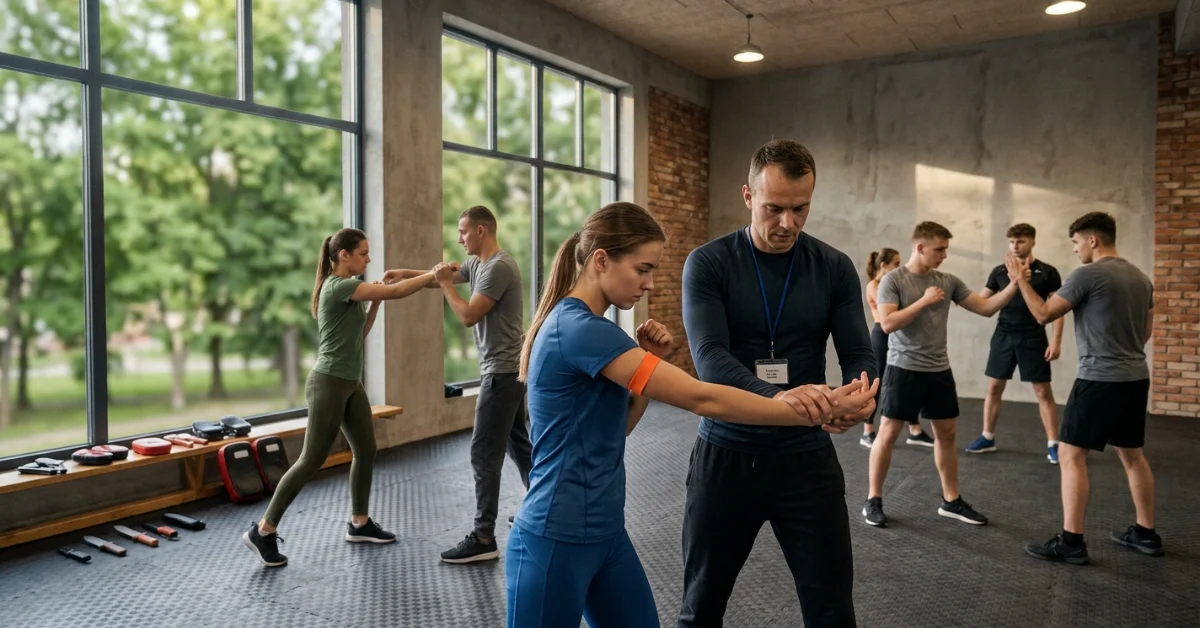
A martial arts coach has been running adult classes for years. One evening a mother walks up and says quietly that her son is being picked on at school, and asks whether he teaches anything for children. Conversations like this are often how a kids self-defense school begins. Parents are not looking for moves for their own sake: they want their child to feel confident and to know how to react in a difficult situation, often after one specific, worrying incident. That shapes the programme, the way you talk to families and your responsibility very differently from a classic martial arts club. Below are the steps, from choosing a system to your first students.
Note: this article is general guidance, not legal advice. Rules differ between countries (for example the UK, Ireland, the US, Canada and Australia) and change over time, so check the formalities and insurance with your local business registration office or tax authority, an accountant and an insurer.
Self-defense for kids: choosing a system and age groups
Before you deal with paperwork and a venue, answer one question: are you teaching a specific system (say, a children's version of Krav Maga, aikido or jiu-jitsu) or your own programme that mixes elements of several martial arts with assertiveness and conflict avoidance? Both make sense, but they give you a different programme, different marketing and different parents: some look for a known system brand, others for the result, which is a more confident child, whatever the style is called. If you run a broader school, see also how to start a martial arts school.
The age split matters just as much. As a rough guide: the youngest children need classes built on play, coordination and simple safety rules ("say no, walk away, tell a grown-up"), school-age children are ready for systematic technique and scenario work, and teenagers can practise more realistic situations. Putting too wide an age range in one group usually ends with classes that feel babyish to the older ones or too hard for the younger ones.
Before you decide, look locally at which kids self-defense classes already exist, what they are missing, and whether there are enough children of the right age within travelling distance (housing estates, primary schools). Compete on your programme and on how you look after a child's emotional safety, not on price alone.
Legal setup and insurance for a kids self-defense school
Running a self-defense school is a business like any other: you need to register it before you take your first payment. For one person, the simplest route is usually to work as a sole trader or self-employed instructor. If several instructors open the school together, or an instructor brings in an investor, consider a company, especially when a larger lease, employing staff or limiting personal liability is involved. Choose the structure with an accountant or lawyer at the planning stage.
Classes with physical contact carry a risk of minor injuries, and working with children on the subject of violence calls for extra care. Agree with your insurer:
- public liability insurance for your activity, and how far it covers contact classes with children,
- whether to consider personal accident cover for participants,
- your terms and conditions, a registration form with the parent's details and a contact number, and written parental consent.
Consent should cover not only taking part in classes but also an awareness that the programme touches on violence and self-protection. The exact set of documents depends on the rules in your country.
Special tip: in your terms and at the first meeting with parents, say plainly what the programme does not cover: it does not teach aggression or "settling things by force", and using techniques outside training is a last resort. Parents who hear this at the start worry less, and children know what you expect of them.
Venue for self-defense classes: mats, space and safety
A room for self-defense has different requirements from a typical fitness studio. Three things to look at first:
- Mats. A floor covered with martial arts mats (tatami or foam mats) is the minimum for any technique that involves falls and throws, even in a gentle children's version.
- Space. Pair drills and scenario work need more room per person than lines facing the front.
- A safe environment. No sharp edges, mirrors or equipment within reach of the children, and a clear view of the whole room for the instructor.
To start, many owners rent a room by the hour in a community centre, a sports club or another martial arts school's hall outside its opening hours. It is a sensible way to test demand without much risk. A studio of your own makes sense only once you have a steady number of groups.
Kids self-defense instructors: qualifications and trust
Growing the school sooner or later means more coaches, and working with children on a subject as sensitive as violence carries a different responsibility from training adults. Beyond skill in the style, look for experience with children and the ability to explain difficult topics in an age-appropriate way without frightening anyone. Check the requirements for qualifications, background checks and training in child protection and first aid under the rules in your country and with your insurer. Write down your child safety rules, including who may be alone with a child and how pick-up after class works; a starting point is our text on attendance checks for children at classes.
Instructors usually work as contractors, invoice through their own business or, in a larger school, are employees. Whatever the arrangement, set the rate, the rules for cancelling classes and who pays for insurance in the contract. A "reserve instructor" for sick days is useful; there is more in how to build a coaching team.
Class offer, timetable and trial classes
Start modestly: one or two age groups, once or twice a week after school. A fixed, predictable timetable builds trust better than a wide but changing offer. Add more age bands and levels only once the first groups fill up.
Plan free trial classes. Signing a child up for self-defense can be an emotional decision, and a parent wants to see first how a group is run. How to organise them is covered in our guide to free trial classes and an open day for a sports academy.
Kids self-defense class pricing: passes, registration fee, workshops
Your billing model affects cash flow as much as your number of students. You can combine three approaches:
- Monthly passes: a fixed amount for a set number of classes per month. They make planning easier, but you need to keep track of payment dates and send reminders.
- Registration fee and family discounts: a one-off fee at first sign-up (it can cover a training uniform) and a discount for a second child from the same family are common.
- Workshops and parent sessions: classes on cyberbullying, online safety or assertiveness can be sold as a separate offer, and they build trust along the way.
Whichever model you pick, write the rules down: does a pass carry over to the next month, what happens to missed classes, how a refund works after a long absence. Missing written rules are a common source of misunderstandings. Ideas for packages are in our article on pricing and promotions for a sports academy.
Getting your first students for a self-defense school
The first group rarely comes from online ads. It is usually the result of a local presence and trust around the subject of a child's safety. To start:
- a Google business profile with your address, opening hours and photos from classes (with parents' consent); see a Google business profile for a sports academy,
- free trial classes or an open day with parents present,
- working with primary schools and after-school clubs, for example a short talk on child safety at a parents' evening,
- a discount for families who bring along their child's friend,
- calm recordings from classes, without scenarios that might upset people, and parents' reviews.
More local actions are in our text on local marketing for extracurricular activities.
Special tip: messages built on fear ("we'll teach your child to survive an attack") put off more parents than they attract. Talk about confidence, boundaries and the ability to ask for help. A parent wants to hear that the child will be calmer, not that the world is dangerous.
How we solved bookings and the timetable for a self-defense school in MyClass
With one group, a spreadsheet and a messaging app are enough. The trouble starts with several age groups, several instructors and passes that run out at different times. This is how we do it in MyClass:
- Groups and sessions: each group has a weekly recurring session, a spots limit, a price and a room or location. You tag the group with its audience (children with age ranges), and if a child outside the range is booked in, the parent sees a warning, although the booking is not blocked.
- Bookings and consent: a parent creates an account, adds the child and books them into a specific session; the guardian's consent for the child to take part is required once. Consents to the terms, accident cover and data protection are also stored on the client's record.
- Limits and waiting list: when a session is full, further people join a waiting list and move up automatically when a spot opens.
- Attendance: the instructor marks attendance on a phone (present, late, absent, excused), and the parent sees the child's latest classes in their account.
- Passes: you define pass types by number of entries or validity, and the system sends an email when a pass is running out (when email sending is switched on).
What we don't do: there are no online payments from clients, so you record payments by hand. There is no separate trial-class type, no make-up classes and no moving a session to another date (you can only cancel it). We don't send text messages or automatically notify a parent about a child's absence. See the pricing or create an account. For more on bookings, read our articles on online class booking for a school or club and the online attendance register.
Checklist before opening a kids self-defense school
- A chosen self-defense system and a starting age group.
- A registered business and public liability insurance.
- Extended parental consent, a registration form and a decision on participant accident cover.
- A room with mats and enough space, even if rented by the hour.
- Instructors with experience of working with children, the required documents and clear contracts.
- A modest, predictable timetable for the first groups, plus trial classes.
- A written price list: passes, registration fee, workshops.
- Communication built on confidence and safety, not on fear.
- A way of handling bookings and attendance that grows with the school.