How to start a tennis school: courts, coaches, pricing
How to start a tennis school: court access and seasonality, paperwork, surfaces, coaches, private and group lessons, pricing and your first students. With a checklist to run through before you open.
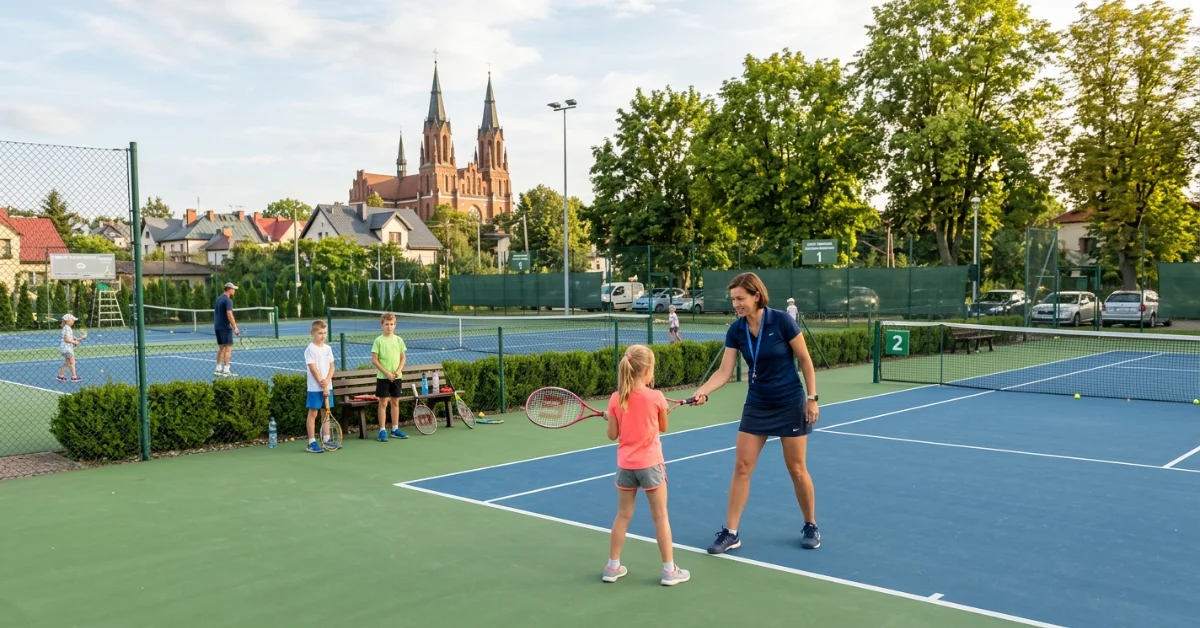
You are a tennis coach, and for three seasons you have been teaching on a rented court: Tuesdays with the kids, Saturdays with the adults. More people keep asking for lessons, but the court is only free in the hours somebody else has given up, and one rainy day a week wrecks the whole timetable. In tennis, unlike most sports, the limiting factor is not the number of instructors but the number of courts. Below we walk through how to start a tennis school (a club, an academy or your own small coaching business) so that it opens and survives its first season.
Note: this article is general guidance, not legal advice. Rules, school calendars and platform terms differ from country to country (the UK, Ireland, the US, Canada and Australia, for example). Check registration, tax and insurance requirements with your local business registry or tax authority, an accountant and your insurer.
How to start a tennis school: courts, season and target group
Before you touch any paperwork, answer one key question: will you have access to indoor courts, or only seasonal outdoor ones? It shapes the whole business plan. A school with an indoor hall runs all year and has steadier income. A school with outdoor courts only has to earn a full year's income in one season and plan for winter, for example by hiring a hall or taking a break from lessons.
Just as important is how you split your groups: mini tennis for the youngest (with balls matched to a child's age and strength), older kids and teenagers, adult beginners and advanced players, plus private lessons. In tennis, private lessons and lessons for two are the norm rather than the exception, so build them into your price list and timetable from the start.
Before you decide, check your local market:
- which tennis schools, clubs and public courts operate nearby, and what they are missing,
- what court hire and lessons cost, and whether you can compete on the quality of your coaches and the availability of slots rather than on price alone,
- whether there is a big enough target group within reasonable travelling distance (housing estates, schools, fitness clubs without their own courts).
Setting up a tennis school: business registration and insurance
Running a tennis school is a business, so you need to register it before you take your first payment. For a coach starting alone the simplest route is often to trade as a sole trader or the equivalent in your country, but the right choice depends on who you go into it with and on what scale. Check registration, contributions and taxes with your local authority and an accountant.
If several coaches open the school together, or a coach teams up with an investor (especially when leasing or building courts is involved), consider a company or partnership. The answer depends on the lease, on hiring staff and on whether you need to limit your liability, so talk to an accountant or a lawyer while you are still planning.
Tennis carries a moderate injury risk compared with contact sports, but public liability insurance and clear terms for your lessons (court rules, how lessons are cancelled, parental consent for children's classes) are standard and protect both you and your students. Ask your insurer what the policy covers when you teach at a venue that belongs to someone else.
Special tip: write down in your terms what happens to a lesson when it rains, before it rains for the first time. With outdoor courts this is the most common source of disputes: is the lesson made up, moved or refunded? Put in the moment of decision too, for example "at the latest 2 hours before the lesson", and say how you will tell your students.
Tennis courts and equipment: surface and facilities
The choice of court affects your costs, your season and your target group more than in almost any other sport. Look at three things first:
- Surface. Clay is gentler on the joints but needs maintenance. A hard court is cheaper to look after and plays faster. The surface also shapes the style of game you teach.
- Indoor or outdoor. An indoor court costs more to hire or build, but you can work all year round. This is usually the single biggest business decision in your plan.
- Extra equipment. A ball machine widens what you can do in training, and racket hire lowers the barrier for beginners who have no kit of their own.
Many schools start by hiring a court by the hour in an existing club or leisure centre rather than leasing or building their own straight away. Building a court is one of the biggest investments in this business, and hiring lets you test demand and build up a base of students before you put money into infrastructure.
Tennis coaches and their qualifications
If you are the only one teaching, quality is in your hands. As the school grows, though, you will sooner or later need more coaches, and that is a different kind of responsibility from teaching lessons yourself. We cover it in our article on how to build a coaching team.
Check real coaching qualifications (as defined by the relevant tennis federation, so look up what applies in your country) and not just a playing career, and look for experience in both private lessons and groups of children, because these are different teaching skills. Agree the form of cooperation (freelance, self-employed or employed) with your accountant, and spell out in the contract the rate for a private lesson and for a group, the rules for cancelling sessions and who pays for insurance.
A good habit is to have a backup coach: even one person who can take over a lesson when someone is ill or two bookings clash, so that a student who has paid for a block is not left without a session.
Court timetable: group lessons and private lessons
Start modestly: a few fixed blocks of hours on the courts, divided between group lessons (mini tennis, juniors, adults) and slots for private lessons. Because a court is a limited resource, the court timetable, and not just the coaches' timetable, becomes your key organisational tool from day one.
Plan a free or low-cost trial lesson, as described in our guide to free trial classes and an open day for a sports academy. Look for extra hours only once demand outgrows your court availability, rather than booking more up front than you can realistically fill. For how to set the size of a group on court, see class size limits.
Tennis school pricing: lessons, passes and camps
Charging in tennis is more varied than in typical group classes, because it combines the cost of the court with the cost of the coach. You can combine three approaches.
Private lessons and lessons for two are charged by the hour or as a block paid in advance (ten lessons at a discount, say). A block improves your cash flow and cuts last-minute cancellations, because the student has already paid for the slot.
Passes for group lessons for children and teenagers are a fixed amount for a set number of sessions a week. They make income easier to plan, but you need to keep track of renewal dates.
Camps and internal tournaments in the school holidays are sold as a separate package, bring extra income and give students a chance to show their progress.
Write the rules down from the beginning: how to cancel a private lesson with enough notice and what happens when there is not enough, whether a block has an expiry date, and how refunds work after a longer injury. For ideas on how to structure your offers, see pricing and promotions for a sports academy.
Finding your first tennis students
Your first group rarely comes from online advertising. It is usually the result of a local presence and word of mouth. At the start these work well:
- a Google business profile with the address of the courts, opening hours and photos (more in Google business profile for a sports academy),
- a free or low-cost trial lesson for people who have "always wanted to try tennis",
- partnerships with local fitness clubs and schools as a referral channel,
- a "bring a friend" scheme with a small discount for both, because tennis is often played in pairs and groups of friends,
- recordings from lessons and internal tournaments on social media (with parental consent for images of children).
We write more about promotion in your area in local marketing for extracurricular activities. If you are also thinking about racket sports beyond tennis, see how to start a padel, squash or badminton club.
How we solved bookings and timetables for a tennis school in MyClass
With a single group, a spreadsheet and a messaging app are enough. Once several coaches and clashing court bookings appear, mistakes start, which is why in MyClass we keep it all in one place. Each group (mini tennis, juniors, adults) has a weekly recurring schedule, a spot limit, a price and a coach. You set up the courts as rooms or locations, and the system warns you when two groups take the same court at the same time (this is a warning you confirm, not a hard block). When a session is full, the next person goes on a waiting list and moves up automatically when someone cancels.
Private lessons are handled by a separate module: the coach sets recurring availability (day, hours, price), and bookable slots are created from it. For groups there are passes with a set number of entries or a validity period, and when a pass is running out the participant gets a reminder by email (as long as the school has email sending switched on). The coach marks attendance on a phone. When rain cancels a session, you cancel that specific date with the reason "weather conditions", the people booked in are notified and pass entries are returned.
What we don't do: there are no online payments for classes, passes and lesson blocks, so you mark payments by hand. There is no make-up lesson feature or moving a session to another date, and private lessons do not use passes. There is also no separate trial class type and no "level" field, so you describe the level in the group name. Your rules for rain and cancellations go in your terms, and the system only makes them easier to carry out. Check the pricing or create an account. More on bookings: online class booking for a school or club.
Checklist before opening a tennis school
- Court access defined (indoor or seasonal) and a target group for the start.
- Business registered and public liability insurance in place.
- Terms for lessons with rules for cancelling and for rain.
- A court with a suitable surface, even if hired by the hour in an existing club.
- Qualified coaches with clear contracts, plus one backup.
- A modest, predictable court timetable split between group and private lessons.
- Price list: private lessons, group passes, camps and tournaments.
- A plan for your first students: Google profile, local clubs, referrals.