How to Start a Kids Basketball Academy: Court, Pricing
How to start a kids basketball academy: format and age groups, legal setup, insurance, court and balls, coaches, pricing for parents and where your first players come from.
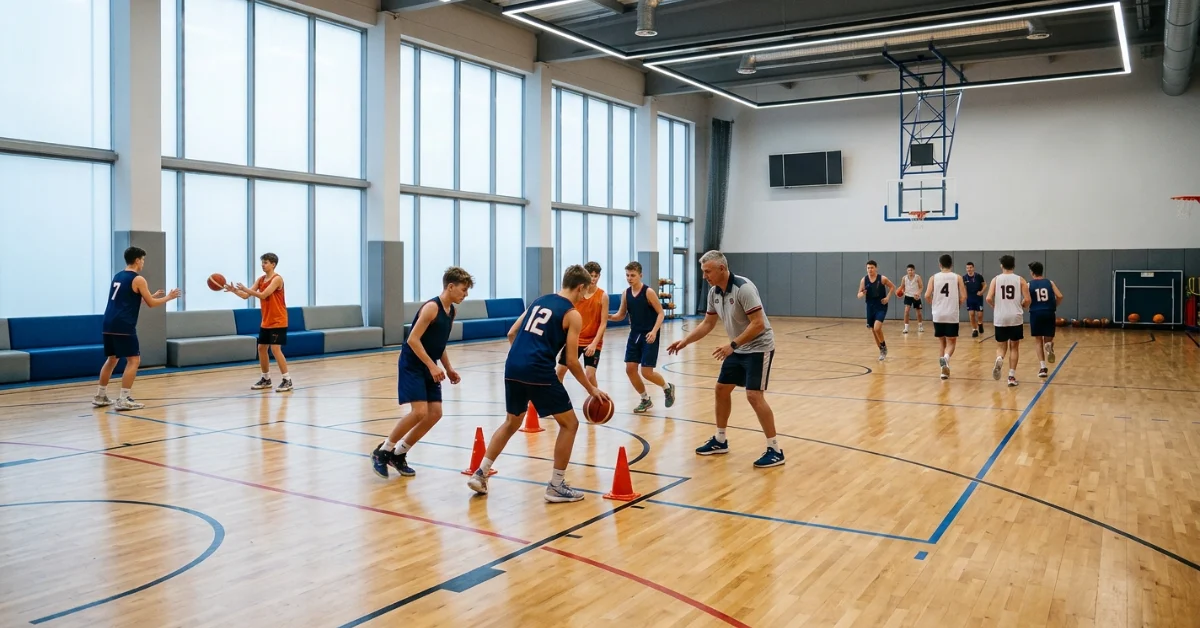
You have played and coached for years, and since September you have been running your first group of kids in a school gym on rented hours. After practice the parents ask whether there is a session on Wednesday too, how much a month costs and whether the little brother can come along. That is when it becomes clear that knowing how to teach is not enough. To start a kids basketball academy (a youth club, a basketball school, basketball classes for children) you need a court, groups matched to age, coaches and rules that you write down before anyone asks about them.
Note: this text is general guidance, not legal advice. Rules differ from country to country (for example the UK, Ireland, the US, Canada or Australia), so check business registration, tax and insurance requirements with your local authorities, an accountant or tax adviser and your insurer. Coaching requirements and competition rules come from your national or regional basketball association. Check the rules that apply in your country.
Kids basketball academy format and age groups
Start by answering one question: are you running recreational classes (basics, play, fitness), or building a pathway into a youth league, with training several times a week and games in competitions? Both make sense, but they need a different programme, timetable and parents: some are looking for movement for their child, others for a clear sporting route.
The age split matters just as much. The youngest (about 6 to 8) need play, coordination and lower hoops. Children aged 9 to 12 are ready for steady work on technique and the basics of team play. Teenagers can train more often, in line with the age categories of the competitions, which your association publishes. A range that is too wide in one group usually ends with practice that is too easy for the older kids or too hard for the younger ones.
Before you decide, check the local market:
- which academies, clubs and courts operate nearby and what they lack,
- which classes and passes are on offer close by and whether you can compete on programme rather than price alone,
- whether the nearby primary schools and neighbourhoods have enough children within a sensible distance of the court.
Legal setup of a basketball academy: business form and insurance
You need to register the academy before you accept the first payment. For a single coach the simplest option is often to work as a sole trader or self-employed instructor, and once several coaches start or a partner joins, consider a company or a non-profit club. Talk through the choice of form and the way you invoice with an accountant while you are still planning.
Before a child joins a group, arrange public liability insurance for the activity, consider accident insurance for participants and get a written consent from the parent or guardian. Basketball carries a risk of injury (twisted ankles, contact in play), so discuss the scope of the policy with your insurer rather than assuming it. Prepare a simple set of terms and a sign-up form too: parent details, an emergency contact, consent to take part.
Special tip: add a question to the form about health matters relevant to training (allergies, injuries, medication), noting that the parent answers it voluntarily. A coach who knows about a child's asthma reacts faster than one who finds out in the middle of a game.
Basketball court and equipment: hoops, floor, balls
A basketball court has different requirements from a typical fitness room. Three things to check first:
- Hoop height. For the youngest, the hoops should be adjustable. Mini basketball rules allow a lowered height, so check with your association which parameters apply. Without that, children have no chance of a successful shot and soon lose heart.
- The floor. Wooden or sports flooring with good grip. A slippery floor increases the risk of falls and joint injuries.
- Balls in the right sizes. Younger children usually use smaller and lighter balls. Choose the size by age and category according to your association's guidance, because a ball that fits is the foundation of learning correct technique.
Many beginners start by renting a court by the hour (a school gym, a sports centre, a club outside its own hours) instead of signing a long lease. That is a sensible way to test demand without much risk. Your own venue only makes sense once you have a stable number of groups. In the rental agreement, settle fixed slots, what happens to cancelled hours (holidays, school tournaments) and who is responsible for equipment.
Youth basketball coach: qualifications and working arrangements
As long as you teach alone, the quality of training is in your hands. Growing the academy usually means more coaches, and working with children takes different skills from coaching adult players. When recruiting, check not only the coaching qualifications your association requires but also real experience with children and the ability to run sessions that engage rather than merely instruct.
When working with minors, find out which background checks and training (first aid, for example) apply in your country, and treat them as the academy's standard even if nobody checks. Coaches may work as self-employed contractors, on part-time contracts or as employees, which you should settle with an accountant. Whatever the form, agree a rate per session or per group, cancellation rules and who covers the coach's insurance. Keep a "substitute coach" too, who can take over the group when someone is ill, so no one is left without practice. We write more about the team in how to build a coaching team.
Basketball sessions and the timetable at the start
Start small: one or two age groups and one or two sessions a week in the afternoon, after school. A stable, predictable timetable builds more trust than a wide but changing offer. When the groups fill up, add more categories or levels rather than opening everything at once. A trial session is also a good move, because it removes the doubts of undecided parents; how to organise one is covered in free trial classes and open days for a sports academy.
Basketball academy pricing: how to charge parents
Your billing model affects cash flow as much as the number of players. The most common approaches can be combined:
- Monthly pass: a fixed fee for a set number of sessions. It makes forecasting easier but means you have to watch renewal dates.
- Registration fee and sibling discount: a one-off charge at sign-up (for a kit, say) or a discount for siblings are ways to build loyalty, if you have worked out that it pays off.
- Tournaments and camps: an extra, closed offer in the school holidays that shows the children's progress and brings in income out of season.
Whatever the model, write the rules down from day one: whether a pass carries over to the next month, what happens to missed sessions, how a refund works after a long absence. Rules that are not written down are a common cause of disputes with parents. For ideas see pricing and promotions for a sports academy and holiday camp registration.
Finding your first basketball players
The first group rarely comes from online advertising; more often it comes from a local presence and recommendations. What works at the start:
- a Google business profile with the court address, hours and photos (children only with parents' consent),
- a trial session or an open day with parents taking part,
- working with primary schools and PE teachers, for example a short demonstration in a lesson or at a parents' evening,
- referrals: "bring a friend", with a small discount for both families,
- short clips from practice and internal tournaments.
More ideas in local marketing for extracurricular activities.
How we solved booking and scheduling for a basketball academy in MyClass
With one group a spreadsheet and a group chat are enough. The trouble starts with several age categories, several coaches and passes that run out on different days. With us you set up each group (for example "ages 6 to 8", "ages 9 to 12") with a weekly recurring slot, a place limit, a price, a coach and a room. You assign the group its audience: children in age ranges, teenagers or adults. If you train in two venues, you add them as locations or rooms, and when hours overlap in the same room you get a warning.
A parent creates an account, adds their children, confirms the guardian's consent once and books them into a specific session. When a session is full, the next child goes onto a waiting list and gets the place automatically when someone cancels. At practice the coach checks attendance on their phone, and a pass has an entry limit and/or a validity period, so you can set up a monthly pass. Internal tournaments can be entered as events with a place limit.
What we don't do: parents don't pay online, and "paid" is a flag you set by hand. There is no separate type of trial class, make-up lesson or moving a single session (you can only cancel it). A parent can't report an absence in the app, and we don't notify you automatically when a child is absent. Skill level isn't a field of the group, so you put it in the name and description. Related reading: online class booking, class waiting list and online attendance register. You can check the pricing or create an account straight away.
Checklist before opening your basketball academy
- A format (recreational or competitive) and the age groups to start with.
- A registered business and public liability insurance.
- Parent consents, a sign-up form and participant accident insurance considered.
- A court with adjustable hoops, a good floor and balls in the right sizes, even if rented by the hour.
- Coaches with experience of children, the required documents and clear agreements.
- A predictable timetable for the first groups and a trial session.
- Written pricing: passes, registration fees, tournaments and camps.
- A plan for the first players: Google profile, schools, referrals.
If you also run other team sports, take a look at how to start a volleyball club and how to start a football academy, and for the form of the whole organisation read how to set up a sports club.