How to start a climbing school: wall, gear, costs
How to start a climbing school: choosing a profile, your own wall or rented time, insurance, belaying procedures, gear records, courses and pricing with a worked cost example.
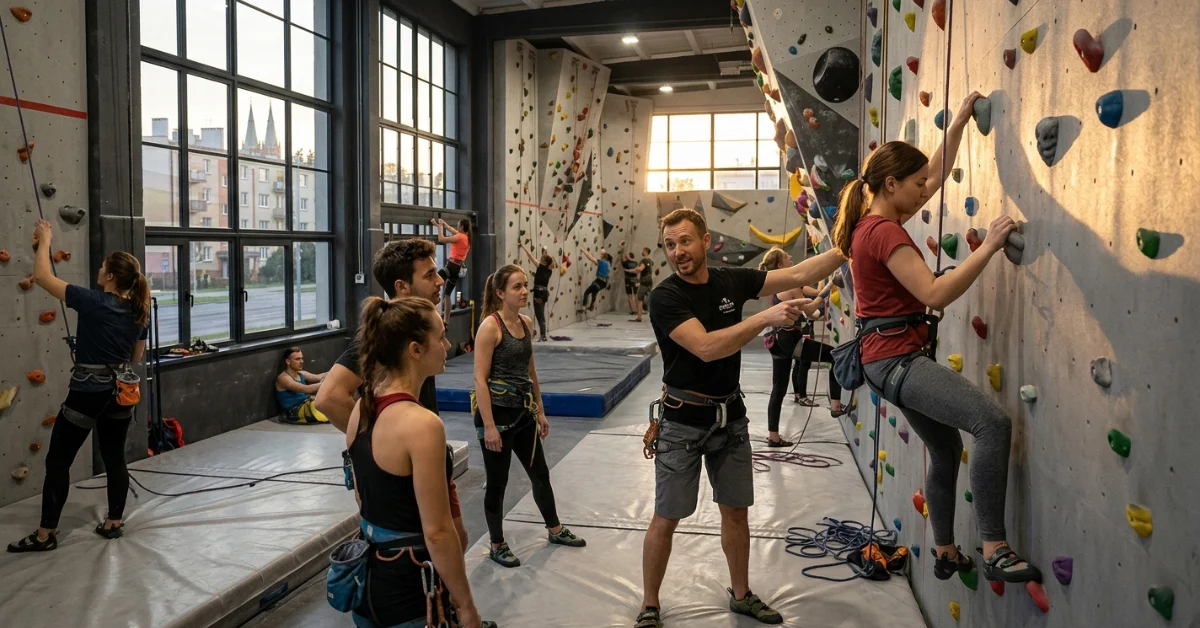
For eight years you have been taking beginners up somebody else's wall, in the evenings and at weekends, employed by the owner of a bouldering gym. Friends keep asking whether you could run those "first steps" sessions properly, with your own group and your own timetable. Before you start a climbing school (or a climbing club, a course business, your own climbing academy) there are a few decisions that shape everything else: what you teach, where, with whom and for how much.
Note: this article is general guidance for several countries (for example the UK, Ireland, the US, Canada and Australia) and is not legal advice. Rules on registering a business, insurance, child safeguarding and instructor qualifications differ from country to country, so check with your local business registry or tax office, your accountant, your insurer and the operator of the wall you will use.
Climbing school profile: bouldering, ropes or outdoor crags
Climbing is really several different worlds. Bouldering happens low, without a rope, over crash mats, and it is the easiest place to begin: nobody has to belay a partner, so a beginners' course is simpler to run. Roped climbing on an indoor wall needs belaying, knot checks and more formal procedures. On top of that come outdoor crags, sessions for children and teenagers, and performance training.
Most people start with a "first steps" course, because it attracts people who have never touched a wall. Kids' sessions follow different rules from an adult course: shorter blocks, more play, a different number of adults per group. If you plan to run both, treat them as separate offers with separate groups.
Setting up a climbing school: paperwork and insurance
The usual options are sole trader or self-employment, a company, or a non-profit association or sports club. Each has different tax obligations, so talk the choice through with an accountant. Whichever form you pick, prepare:
- public liability insurance that explicitly covers climbing sessions,
- terms of participation and a participant statement acknowledging the risks, plus consent from a parent or guardian for under-18s,
- rules for handling participants' personal data.
Climbing is a higher-risk activity, so your policy and paperwork matter more than for most classes. Ask your insurer directly whether the policy covers running courses, roped climbing and bouldering, which instructor qualifications it expects and how many participants it allows per instructor. The differences in cover usually only show up when there is a claim, so it is better to ask before you start. Also check the requirements for instructors and for running sessions under the rules that apply in your own country.
How much does it cost to start a climbing school
The cost of starting depends mostly on whether you build your own wall or work with an existing one. Items in order of weight:
- the venue: building a wall or hiring hours on an existing one,
- instructor pay,
- insurance and accounting,
- equipment: harnesses, shoes, belay devices, ropes, chalk,
- equipment inspections and replacement,
- marketing and a booking tool.
Example (hypothetical figures, not a price list, in pounds for illustration): an hour on the wall costs £60, the instructor £35, and equipment and insurance add £10 per hour. One course hour then costs £105. With 7 participants that is £15 each, with 3 participants £35 each. The number of people per instructor is capped for safety reasons, so you cannot lower the cost by squeezing more people into a group. In this sport what counts is fixed course hours and high attendance, not inflated groups.
Climbing wall: build your own or rent time
The biggest decision is the venue. Your own wall means a high up-front cost: the structure, holds, mats, ventilation and a building with enough height. For most new climbing schools it is more sensible to work with an existing wall or bouldering gym: hire hours, run courses during its opening hours, or agree a commission model. When you choose a venue, check:
- inspection records for the structure and anchor points, and the condition of the mats and holds,
- how many people fit in the teaching area without getting in the way of other customers,
- availability at the times your students can make (evenings and weekends),
- whether the venue allows outside instructors and on what terms.
If you hire hours, put the fixed time slots in a written agreement. A school whose timetable depends on the mood of the front desk will never build regular groups.
Belaying and safety procedures at a climbing school
This part must not be simplified. Write the procedures down and follow them without exceptions: harness and knot checks before every climb (for example partner checks), clear commands between climber and belayer, lowering rules, fall zones in bouldering and how to jump down. Decide how many people each instructor is responsible for, who leads first aid and what you do after a fall.
You teach belaying step by step, and you only sign someone off for independent belaying after a practical test. Written rules also help in conversations with your insurer and put participants at ease.
Special tip: record each belay sign-off as a short card with the date and the instructor's signature. When someone comes back after a year away, you know what they passed and where to restart.
Climbing gear and keeping equipment records
To begin with, rental kit is usually enough: harnesses, shoes, chalk, belay devices and, for roped courses, ropes. Climbing equipment has a limited life, so keep records from day one: when it was bought, how often it is used, when it was last inspected, when to retire it. A card for every rope and harness is enough, instead of guessing whether a rope is still fine. Mark and set aside retired kit so it does not return to use by mistake. Manufacturers' guidance on inspection and replacement overrides your own feel for it.
Climbing instructor: qualifications and teaching beginners
A school is only as good as its instructors. Look for people with instructor qualifications and experience of teaching beginners. A good climbing instructor does not just know technique, but also assesses risk, spots belaying mistakes and can calm someone who is afraid of heights. Check which qualifications your policy and venue require, and base your hiring on them. If you work with children, there are also child safeguarding requirements, which again differ from country to country. We write about building a team in how to build a coaching team.
Climbing courses, levels and pricing
Start with clearly described courses: "first steps" (for example four sessions), a belaying course, a kids' course, a technique session. Participants want to know what they will learn and what comes next. Levels give the offer a structure: after the beginners' course a climber moves to the belaying course, then to training.
In your price list, work out the cost of one session as in the calculation above. Packages work well (a course of several sessions), followed by a pass for visits or a monthly training plan. Set cancellation and absence rules up front, because the wall and the instructor are paid for regardless of attendance. You will find more on building a price list in pricing and promotions for a sports academy.
Finding your first climbing students
Climbing has strong communities: mountaineering clubs, local groups, companies looking for activities for their teams. Start with trial sessions and an open day, described in the guide free trial classes and open day for a sports academy. Set up a Google Business Profile, ask your first students for reviews and add photos from courses only with participants' consent.
An idea specific to climbing is an offer for companies: a single "first time on the wall" session for a team is a good chance to show off the school, and some people may stay on for a course.
How we solved booking and timetables for a climbing school in MyClass
Climbing has a cap on people per instructor, so every place and every absence counts. With us you create a course or group as a class with a weekly recurring slot, a place limit, a price, a coach and a room (the wall). Rooms and locations can be set separately if you teach at two venues, and if the hours of the same room overlap you get a warning. A course run as a block of sessions (for example "first steps") is added as a course with a single sign-up.
The participant books online for a specific date, and you approve requests (or switch on auto-approval). When a session is full, the next person goes on a waiting list, and when someone cancels the first person on the list gets the place automatically. The instructor takes the register on a phone: one tap marks present, late, absent or excused. A pass has a limit on visits and/or an expiry date, and the school chooses whether a visit is used up on attendance or on booking. We send the email about a pass running out once per pass.
What we don't do: customers don't pay online, and "paid" is a flag you set by hand. There is no separate class type for trial sessions or make-up sessions, and a single date cannot be rescheduled, only cancelled. We also don't keep equipment records or a "level" field on a group, so you describe the level in the name and description. Related articles: online class booking for a school or club, class size limits and online attendance register. You can check prices on the pricing page and set up an account in a few minutes.
Checklist before opening a climbing school
- A chosen profile: bouldering, ropes, children or training.
- A legal form, public liability insurance and terms with a participant statement.
- An agreement with the wall for fixed hours.
- A cost-per-hour calculation and the break-even number of students.
- Qualified instructors and written safety procedures.
- Equipment with inspection records.
- Courses with levels and a price list built up from your costs.
- A plan for finding students: trial sessions, Google Business Profile, clubs and companies.
Many people also think about widening the offer with general fitness training; in that case read how to start a CrossFit gym, and for the structure of the whole club see how to set up a sports club.